
You picked your goal: improve my sleep quality. You're expecting a list of supplements, a meditation playlist, and maybe a recommendation for a white noise machine.
That's what most wellness apps would do. Hand you a toolkit on day one and hope something sticks. By Thursday you've bought melatonin and downloaded three ambient sound apps. By Sunday you're still lying awake wondering why none of it worked.
Wellbody takes the opposite approach. Your first week has no supplements, no sleep gadgets, and no rigid bedtime rules. Instead, it builds something most people skip entirely: awareness of what's actually happening before, during, and after your sleep. Here's what seven days of that looks like.
Day 1 - "The Sleep Sanctuary"
You open the app and get three actions. The first is "Create Your Sleep Journal" - not a sleep tracker app, not a wearable sync, just a written record of when you go to bed, when you wake up, and how you feel about it. The second, "Set the Mood," asks you to look at your bedroom with fresh eyes. The third, "Mindful Wind-Down," introduces a brief breathing practice before bed.
All three sit in the body health domain. All three are completable in under ten minutes. And none of them ask you to change anything about your sleep yet. Day one is about observation, not optimization. You're building a baseline.
Day 2 - "Tracking Patterns"
The theme shifts to pattern recognition. "Reflect on Last Night" has you revisit your journal and start connecting dots - what you ate, how active you were, what your evening looked like. Then something unexpected happens. Your second action, "Healthy Fuel for Sleep," comes from the Nutrition domain. On day two of a sleep goal, the system is already showing you that sleep isn't just about what happens in the bedroom.
The third action, "Communicate Your Needs," is about talking to the people you live with. Sleep doesn't happen in isolation, and Wellbody accounts for that from the start. Two days in and you're already working across body health, nutrition, and your social environment.
Day 3 - "Creating Comfort"
Now the system builds on what you've noticed. "Evaluate Your Environment" asks you to assess your bedroom based on what you've tracked so far - not based on a generic checklist someone else wrote. "Journal Entry Focus" deepens your tracking to include daytime stressors. And "Incorporate Short Breaks" introduces movement into a sleep goal, because tension that builds during the day follows you to bed.
Notice the progression. Day 1 was pure observation. Day 2 introduced connections between sleep and other areas of your life. Day 3 is the first day you're asked to make small adjustments, and those adjustments are informed by two days of your own data.

Day 4 - "Rituals and Routines"
This is where structure starts to form. "Establish a Bedtime Routine" isn't a rigid protocol. It's a prompt to build a calming sequence that works for your life - reading, stretching, music, whatever signals your body that the day is ending. The second action, "Nutrition Check-In," pulls from the Nutrition domain again, connecting your meals from the past few days to how you've been sleeping.
The third action is another "Mindfulness Moment" - the same breathing and visualization practice from day one, but now it's part of something larger. It's not a standalone technique. It's the final step in a routine you're designing yourself.
Day 5 - "Assessing Progress"
Halfway through, the system asks you to step back. "Review Your Journal" turns your five days of tracking into actual insight. What patterns emerge? What seems to help? What keeps disrupting your sleep? "Adjust Your Environment" asks you to act on those patterns. And "Plan a Relaxing Evening" introduces a technology-free night - not as a permanent rule, but as an experiment you can evaluate.
Five days in and you still haven't been told what time to go to bed. You haven't been prescribed a supplement stack. You haven't been told your phone is ruining your life. All you've done is track, reflect, and make small adjustments based on what you've noticed. The system trusts you to find the patterns. It just gives you the structure to look.
Day 6 - "Reinforcing Habits"
Day 6 is about locking in what's working. "Consistency is Key" asks you to commit to the journal and bedtime practices that felt right this week. The Nutrition domain returns with "Nourish for Sleep" - a prompt to prepare a dinner built around foods that support sleep quality, like fish, nuts, and leafy greens. And "Engage in Evening Reflection" adds a gratitude practice to your journal.
In week 1, Wellbody delivers 21 actions across 7 days for the sleep quality goal. 18 are body health actions spanning journaling, environment design, and mindfulness. 3 are Nutrition actions connecting what you eat to how you sleep. Zero are about supplements, sleep gadgets, or rigid bedtime schedules. The system builds self-awareness first, because you can't fix a sleep problem you haven't actually observed.
Wellbody builds the system for you.
3 daily actions across fitness, nutrition, mindfulness, and recovery.


That gratitude practice isn't filler. Research consistently links gratitude journaling to reduced pre-sleep worry. But Wellbody doesn't introduce it on day one when you're still building the habit of writing anything at all. It waits until day six, when the journal is already part of your evening. Timing matters as much as the technique.
Day 7 - "Celebrating Success"
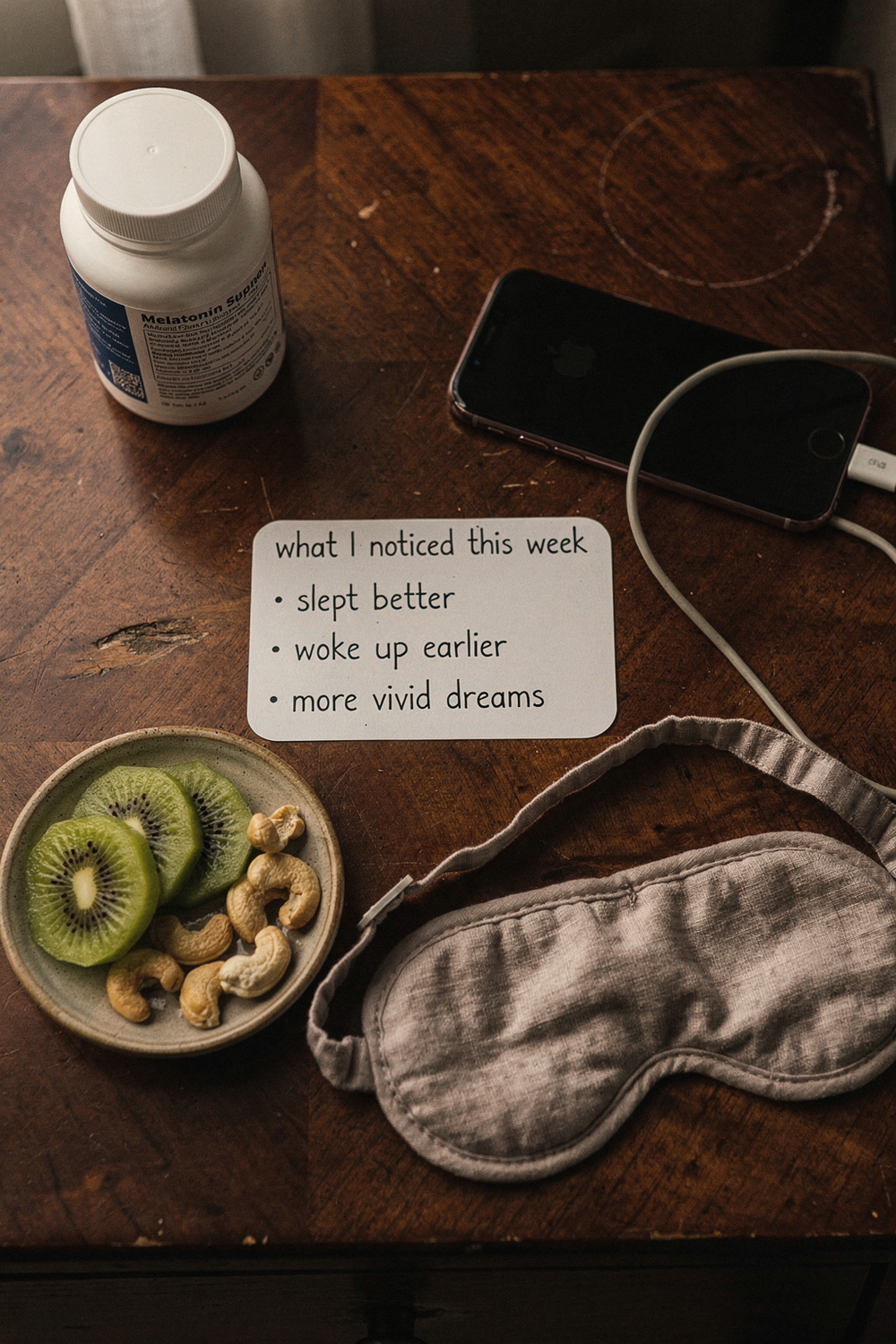
The first action on the final day is "Celebrate Your Journey." Not "measure your sleep score." Not "compare yourself to a benchmark." Celebrate. The system marks progress before asking for more because acknowledging what you've built is what makes you want to keep building.
"Final Journal Reflection" asks you to summarize the week - improvements, challenges, surprises. And "Plan for Next Week" shifts from looking back to looking forward. You're setting your own goal for week two based on everything you've learned. The system doesn't decide what comes next in a vacuum. It builds on the foundation you just created.
What you didn't do this week
You didn't download a sleep tracker. You didn't take melatonin. You didn't set a mandatory 10 PM lights-out rule. You didn't buy anything.
What you did do: you observed your sleep patterns for seven nights, connected your nutrition and daytime stress to your sleep quality, designed a bedtime routine that fits your life, and built a journaling habit that gives you real data about what works for you.
That's not less than what a wellness app typically offers in week one. It's more. It's just quieter.
What happens next
Week 2 shifts focus to identifying your specific sleep disruptors - the habits, foods, and stressors that are working against you. Week 3 introduces a consistent sleep schedule built on the patterns you've tracked. By week 4, you're layering in relaxation techniques that extend your wind-down routine.
The entire first phase spans six weeks and covers sleep awareness, environment design, scheduling, and stress management. Each week adds one new layer to the foundation you built in week one. Nothing gets thrown at you all at once.
Better sleep doesn't start with buying the right pillow. It starts with understanding why you're not sleeping well in the first place. Week one gives you that understanding. Everything else builds from there.
About Wellbody
Wellbody is a body-health app that replaces the stack. One goal. Three daily actions. Fitness, nutrition, mindfulness, and recovery - connected behind the scenes so you don't have to manage the pieces. The plan adjusts around what you actually did today, and grows with you: month six looks nothing like month one. No dashboards, no re-planning. You just keep showing up.